Friday, November 09, 2012
SBLGNT in TC
In TC 17 (2012), we just published our second panel review of this year. This time, it concerns contributions made by Michael Holmes, David Parker, Harold Attridge, and Klaus Wachtel, during the 2011 SBL meeting, discussing the SBLGNT edition. Next to the discussion, there is a list compiled by Klaus Wachtel of the differences between SBLGNT and other editions, most notably Nestle-Aland (still 27).


Wednesday, October 17, 2012
The Text of the New Testament Today (Baarda Aland Symposium)

Yesterday (October 16, 2012), we had an exciting symposium here in Amsterdam, entitled The Text of the New Testament Today. It was a symposium in honour of Prof. em. Tjitze Baarda on the occasion of his eightieth birthday and celebrating the publication of the New ‘Nestle-Aland’ (NA-28). The symposium was organised by the Amsterdam Centre of New Testament Studies (ACNTS) in cooperation with the Institut für Neutestamentliche Textforschung (Münster). We were very privileged to have Prof. Barbara Aland and Dr Klaus Wachtel in our midst, as well as a number of outstanding New Testament colleagues from the Netherlands.
The first part of the meeting (chaired by Dr Arie Zwiep) was on our
department’s project on Conjectural Emendation. Dr Jan Krans introduced us into
the world of Conjectural Criticism in a presentation entitled “Rückblick und Ausblick. Konjekturalkritik im Nestle und Nestle-Aland
(1898 bis heute)”.
 Prof. Bert
Jan Lietaert Peerbolte then lectured on Friedrich Blass’ attempt to restyle
Matthew 23:8-10, and Drs Bart
Kamphuis presented part of his work for this project under the title “Straatman,
the Silenced Women and the Resurrection: The Curious Origin of the Conjectured
Omission of 1 Cor. 14:34-35”.
Prof. Bert
Jan Lietaert Peerbolte then lectured on Friedrich Blass’ attempt to restyle
Matthew 23:8-10, and Drs Bart
Kamphuis presented part of his work for this project under the title “Straatman,
the Silenced Women and the Resurrection: The Curious Origin of the Conjectured
Omission of 1 Cor. 14:34-35”.

The second part of the meeting (chaired by Prof. Martin de Boer) was on the
new Nestle-Aland (NA-28). Dr Wachtel introduced us to the ins and outs of the
new edition and Prof. Aland shared some personal memories of her work with the
Committee members (most of them no longer among us), and expressed her gratitude
for the scholarly work of Tjitze Baarda and their longstanding friendship. She
presented the first copy (not really the first, of course) of NA-28 to Baarda
as a token of appreciation. NA-28 has made its entry into the Netherlands!
Tolle, lege!!

Arie Zwiep (ACNTS, VU University)
[Two images added, Jan Krans, 18/10/2012]
Thursday, August 23, 2012
Working on a different (floor) level
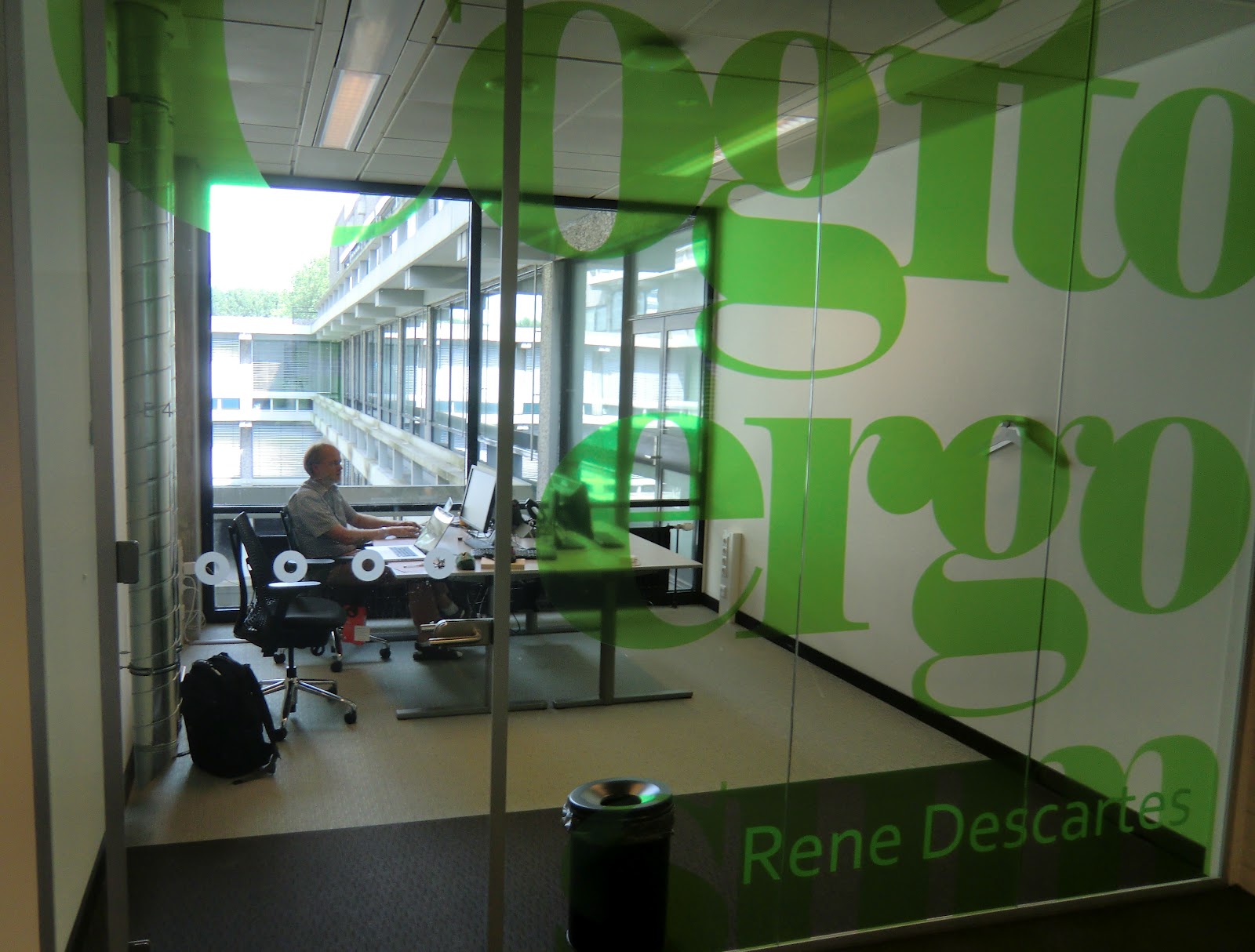

Anyway, we are back at work; here in a room with two desks, of which we use only one to share a screen (and forget about the Windows computer normally attached to it).


Thursday, June 07, 2012
RBL Reviews of MC de Boer's Galatians Commentary
Dear all,
See http://www.bookreviews.org/bookdetail.asp?TitleId=8373 for two recent reviews of our esteemed colleague's commentary on Galatians.
[To avoid a possible conflict of loyalty between my Doktorvater and my current boss I promise herewith that - if time and subsidizers permit) - I'll write a commentary on Galatians myself, written from the newest possible perspective ... :-)]
Arie Zwiep
See http://www.bookreviews.org/bookdetail.asp?TitleId=8373 for two recent reviews of our esteemed colleague's commentary on Galatians.
[To avoid a possible conflict of loyalty between my Doktorvater and my current boss I promise herewith that - if time and subsidizers permit) - I'll write a commentary on Galatians myself, written from the newest possible perspective ... :-)]
Arie Zwiep
Thursday, March 29, 2012
Bowyer's 1763 Collection of NT Conjectures
It took some time, but now, thanks to the Göttinger Digitalisierungszentrum, the first edition of William Bowyer’s collection of New Testament conjectures is available online (or here). It is part of the second volume of Bowyer’s (very rare) 1763 Greek New Testament (the first part of this second volume is found here or here). Thus far we could had to go to the Library of the Leiden University to consult it.
For our project here at VU University this edition is important, even though it contains far fewer conjectures than later editions (1772; 1782; 1812). For a number of New Testament conjectures, it is simply the earliest source there is.
Update 17 May 2013: added some links, as the GDZ ones do not seem to work.
For our project here at VU University this edition is important, even though it contains far fewer conjectures than later editions (1772; 1782; 1812). For a number of New Testament conjectures, it is simply the earliest source there is.
Update 17 May 2013: added some links, as the GDZ ones do not seem to work.
Monday, January 30, 2012
SBL International, Amsterdam 2012: papers accepted
Members of our research group will present some important papers at the coming SBL International meeting in Amsterdam, in July.
Silvia Castelli will present on Wettstein’s Greek New Testament:
Or perhaps one final presentation can tip the scales for you. Even though the 2012 SBL International meeting will be in my hometown, and I did not really have to submit a paper in order to justify my presence (financially, that is), I could not refrain from the following proposal, which – to my great relief – my co-chair Tommy Wasserman accepted without much ado.
Silvia Castelli will present on Wettstein’s Greek New Testament:
Beyond the Received Text? Discerning Patterns in Wettstein’s Textual DecisionsBart Kamphuis will present on conjectural emendation proper (beware: rather long abstract ahead):
In his Novum Testamentum Graecum 1751-1752, Johann Jakob Wettstein reprints the received text, yet indicating very clearly his proposed omissions, additions, and substitutions. Are there patterns to be discerned in Wettstein’s decision in favour of certain variant readings? And does he somehow motivate his choices? Through a systematic analysis of Wettstein’s changes to the received text, some answers to these questions will be provided.
Problems and Causes: A Classification of New Testament ConjecturesIf this all does not convince you that you should come to Amsterdam and visit the “Working with Biblical Manuscripts” sessions, or even submit a proposal yourself, while you still can (today, January 30, and tomorrow), I throw my hands up in despair.
The reflection upon conjectural emendation of the text of the New Testament has generally been limited to the question to which degree such emendation can be permitted. Little attention has been paid, by contrast, to the corpus of literally thousands of conjectures that have actually been made since Origen. This gap is currently being filled in Amsterdam by the VU University research project New Testament Conjectural Emendation: A Comprehensive Enquiry.
In any research into a large set of data, classifications are made for the purpose of analysis. My study of the conjectures discussed and made in Holland from 1846 to 1906 (what I call the Dutch Movement of Conjectural Criticism) has led to the classification of New Testament conjectures proposed in this paper.
The key to this classification is the idea that, in principle, the reasoning behind every conjecture concerns both the problem as perceived in the transmitted text and the cause of the supposed textual corruption. It turns out that all problems and causes mentioned in the analysed argumentations can be classified into a limited number of types. The classification of conjectures can thus be projected onto a two-dimensional table, with types of problems on the one axis, and types of causes on the other. Every sufficiently substantiated conjecture occupies at least one cell in this table.
This classification makes it possible to discern patterns in the conjectural criticism of particular scholars and even in the history of New Testament conjectural criticism in general.
Or perhaps one final presentation can tip the scales for you. Even though the 2012 SBL International meeting will be in my hometown, and I did not really have to submit a paper in order to justify my presence (financially, that is), I could not refrain from the following proposal, which – to my great relief – my co-chair Tommy Wasserman accepted without much ado.
Who coined the name “Ambrosiaster”?See you in Amsterdam!
Traditionally, the coinage of the name “Ambrosiaster” for the author of an important commentary on the Pauline epistles has been attributed to Erasmus. (“Ambst” is mentioned more than 400 times in the current Nestle-Aland apparatus.) As demonstrated by René Hoven in 1969 already, the attribution to Erasmus cannot be sustained. A recent attempt by Sophie Lunn-Rockliffe (2007) mentions the 1686–90 edition of Ambrose’s works by the Benedictines of St Maur, but their use of the name “Ambrosiaster” can be shown to depend on earlier sources. This paper will establish that Jülicher, in 1894, was pointing in the right direction when he mentioned “around 1600” for the first use of the name “Ambrosiaster”, and solve the riddle of its coinage once and for all.
Wednesday, November 02, 2011
Erasmus, Opera Omnia, Amsterdam edition
In November 2009, I posted on the older Basel and Leiden editions of Erasmus’ Opera Omnia.
As I recently found out, most volumes of the vast and ongoing project of the Amsterdam edition are now online as well, in open access, and as PDF with OCR text. The latter is not perfect, but it still facilitates research enormously, of course.
For New Testament scholars, most important are the sixth “ordo”, with Erasmus’ NT texts and annotations (five volumes available, out of six published so far; two more volumes are to be published shortly), and the seventh, with the “paraphrases” (only one volume so far). Also the ninth “ordo”, with Erasmus’ “apologiae” etc. is important for a good impression of his New Testament scholarship.
But why not see for yourself the real critical Latin edition of the Praise of Folly, or of the Dialogue on the correct pronunciation of Latin and Greek? I could go on, but I won’t, this time.
For more information on the ASD edition, readers are referred to the site of the Huygens Institute.
Finally, most volumes of Allen’s edition of Erasmus’ letters are available at the Internet Archive. This is actualy the third “ordo” of Erasmus’ works, not repeated in the Amsterdam edition.
As I recently found out, most volumes of the vast and ongoing project of the Amsterdam edition are now online as well, in open access, and as PDF with OCR text. The latter is not perfect, but it still facilitates research enormously, of course.
For New Testament scholars, most important are the sixth “ordo”, with Erasmus’ NT texts and annotations (five volumes available, out of six published so far; two more volumes are to be published shortly), and the seventh, with the “paraphrases” (only one volume so far). Also the ninth “ordo”, with Erasmus’ “apologiae” etc. is important for a good impression of his New Testament scholarship.
But why not see for yourself the real critical Latin edition of the Praise of Folly, or of the Dialogue on the correct pronunciation of Latin and Greek? I could go on, but I won’t, this time.
For more information on the ASD edition, readers are referred to the site of the Huygens Institute.
Finally, most volumes of Allen’s edition of Erasmus’ letters are available at the Internet Archive. This is actualy the third “ordo” of Erasmus’ works, not repeated in the Amsterdam edition.
Subscribe to:
Posts (Atom)